Project Overview
This project consists of converting a standard longboard into an electric longboard by designing and integrating all the electronic and control systems.
The objective was not only to make the longboard move, but to understand how electric propulsion systems work, how they can be controlled by software, and how different components interact in a real system.
 Longboard.
Demo video.
Longboard.
Demo video.System Architecture
The electric longboard is composed of the following main elements:
- a brushless motor to drive the board
- an ESC (Electronic Speed Controller) to control the motor
- a LiPo battery system to power the electronics and the motor
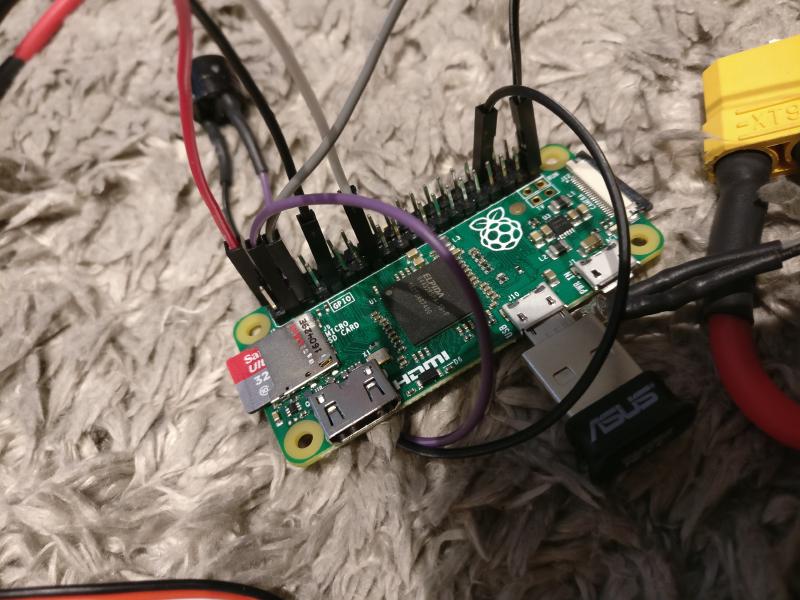
- a Raspberry Pi Zero acting as the main controller
All components were selected and integrated manually, focusing on flexibility and learning rather than using a closed commercial solution.
 Longboard system.
Control System
The Raspberry Pi Zero was programmed in Python and used as the main control unit of the longboard.
The Raspberry Pi handled:
- acceleration control
- braking control
- communication with external devices
To control the longboard, I connected a Wii controller to the Raspberry Pi. The controller inputs were mapped to acceleration and braking commands, allowing smooth control of the board.
Special attention was given to regenerative braking, so that braking commands could recover energy and charge the batteries while slowing down the board.
 Raspberry Pi controller.
ESC Communication and Telemetry
To improve visibility and control, I added a Bluetooth dongle to the ESC.
This allowed:
- reading real-time data from the ESC
- monitoring motor and battery parameters
- visualizing system behavior during operation
The data could be accessed from a mobile application, giving real-time feedback while the longboard was running.
Motor Calibration Tools
Motor calibration was not done manually.
I developed a desktop application that allowed me to:
- calibrate the ESC and motor
- adjust control parameters
- verify correct system behavior before use
This made the setup process safer, repeatable, and easier to tune.
 Motor assembly.
Motor running.
Motor assembly.
Motor running.Learning Outcomes
This project combined power electronics, embedded control, and software development in a single system. The longboard used a brushless motor driven by an ESC, powered by a LiPo battery pack, and controlled by a Raspberry Pi Zero programmed in Python. The control logic handled acceleration and regenerative braking based on input from a Wii controller. A Bluetooth dongle connected to the ESC provided real-time telemetry, which could be monitored from a mobile application. Motor and ESC calibration were performed through a custom desktop application, allowing parameter tuning and verification before operation.