Context and motivation
EnergyPilot was developed as my dual Bachelor’s Final Degree Project in Industrial Electronics and Automation Engineering and Computer Engineering.
The idea came directly from a real problem I faced while building an electric longboard. During that project, I needed a Battery Management System (BMS) that was:
- reliable and safe
- configurable
- capable of fast charging
- and affordable
What I found on the market was either too expensive, not configurable, or designed as a closed solution with very limited control. This made experimentation and iteration difficult, especially for personal or small-scale projects.
Because of this, I decided to design my own BMS, fully configurable and designed from scratch, and then build the software needed to interact with it in a clear and usable way.
What EnergyPilot is
EnergyPilot is a complete battery management system, not just a PCB or an app.
It is composed of:
- a custom-designed BMS electronic board
- a mobile application to monitor and configure the system
- a backend service to store user data and measurements
The system was designed specifically for 3S lithium-ion battery packs, focusing on safety, configurability, and real-time monitoring.
Hardware: custom BMS design
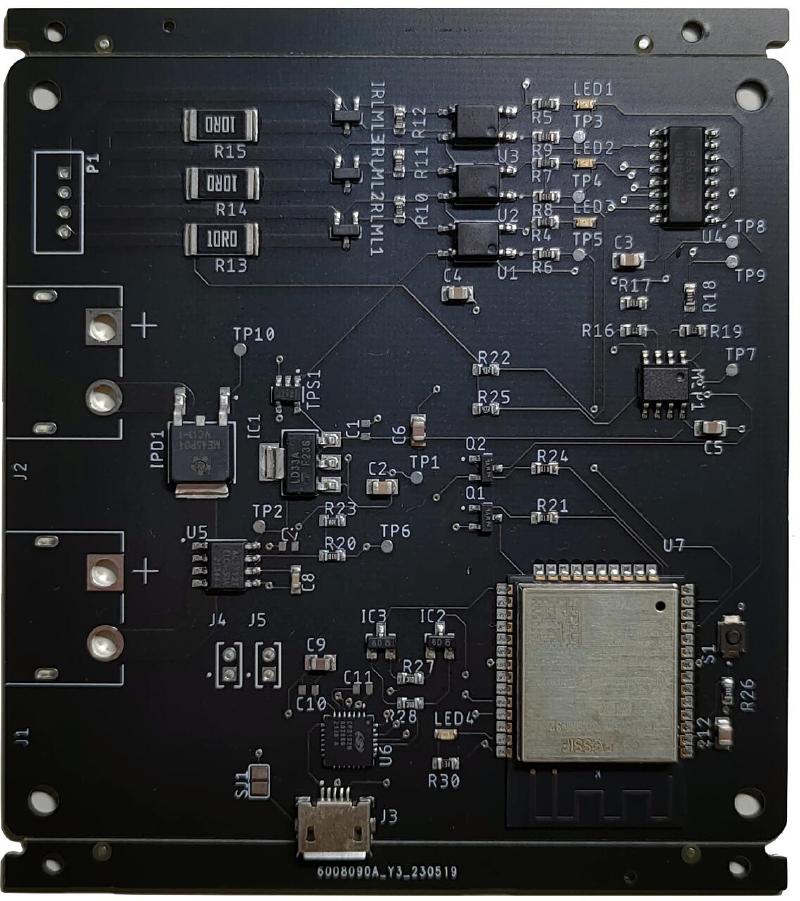
On the electronics side, the project focuses on the design and fabrication of a real BMS, not a prototype module.
 Final product.
The BMS is capable of:
- cell voltage monitoring for each battery cell
- cell balancing during charging to maintain uniform voltage
- current measurement in real time
- overcurrent protection, disconnecting the load when limits are exceeded
- safe cutoff when minimum cell voltage is reached
The board was fully designed by me, including:
- schematic design
- PCB layout
- component selection
- manufacturing constraints
An ESP32 microcontroller is used as the main controller, providing both processing power and Bluetooth Low Energy (BLE) connectivity for communication with external devices.
The goal was to design a BMS that could be configured by the user, instead of being fixed to predefined parameters like most commercial low-cost solutions.
 Final product.
 Schematic.
Fast charging and configuration
One of the key design goals was enabling controlled fast charging.
Through the system, parameters such as:
- maximum discharge current
- balancing voltage
- cutoff voltages
can be configured externally. This allows adapting the BMS to different battery packs and use cases, something that was not possible with the commercial BMS options I found during my longboard project.
All configuration values are stored on the device, so the system continues working correctly even when not connected to the app.
Software: mobile app and backend
To make the hardware usable, I developed a mobile application as the Final Degree Project for Computer Engineering.
The app allows:
- real-time visualization of battery voltage and current
- configuration of BMS parameters via BLE
- clear graphical representation of battery state
In addition to the mobile app, I developed a backend service that:
- stores user data and measurements
- manages authentication
- allows persistent data storage for later analysis
The backend was designed as a REST API and deployed using containerized services.
A complete engineering project
EnergyPilot was designed as a full system, not as separate unrelated parts.
It combines:
- electronics design
- embedded systems
- mobile development
- backend architecture
- user experience
This approach reflects how real engineering products are built: hardware and software designed together, with usability and safety as core requirements.
 Iterating and fixing the project.
Recognition
EnergyPilot was awarded the INETUM Prize for the Best Final Degree Project, recognizing both its technical depth and practical applicability.
Relevant links:
- 🔌 Hardware & app repository:
https://github.com/imanolpg/energy_pilot - 🖥️ Backend repository:
https://github.com/imanolpg/energy_pilot_backend - 🏆 Award announcement:
https://www.linkedin.com/posts/imanol-gutierrez_espaaeha-inteligenciaartificial-premiosaulatecnolaejgica-activity-7162125554383634432-AdUC
Why this project matters to me
EnergyPilot exists because I needed it.
It was born from a real problem, evolved through engineering constraints, and resulted in a system that I fully understand — from electrons moving through the PCB to data shown on a screen.
This project strongly defines how I approach engineering today:
identify real problems, design complete systems, and keep the user in control.