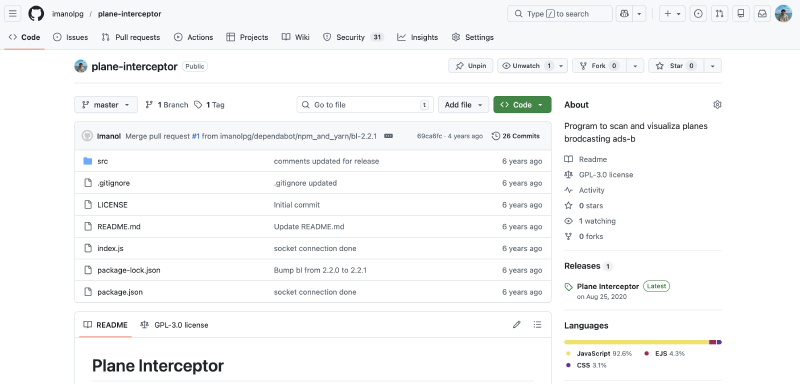
Why I built this
Plane Interceptor started from a simple but deep curiosity: I wanted to learn how Software Defined Radio (SDR) works and how it is possible to locate airplanes by listening to radio signals.
Since I had seen people track flights online, I wondered: Can I do something similar with my own hardware and code? In this project I discovered how signals that airplanes broadcast can actually be received and shown using software — and that learning process was the most important part for me. oai_citation:1‡GitHub
What it does
In simple terms, Plane Interceptor:
- listens to ADS-B radio signals broadcast by aircraft
- uses existing tools to decode those signals
- shows aircraft locations and basic data in a simple interface
This is not a full radar system or a complex signal decoder — instead, it uses tools that already know how to interpret ADS-B and focuses on connecting those tools with the rest of the system in a way I could understand and control. oai_citation:2‡GitHub
Technologies I used
Even if the core signal decoding was done by existing software, this project brought together several technologies, and each choice had a reason:
- JavaScript — The main language used in this project, chosen because it makes it easy to build simple interfaces and glue different pieces together. It also let me quickly test ideas in the browser. oai_citation:3‡GitHub
- Node.js — Used to run scripts that connect the SDR output with the visualization logic, and to handle the real-time data flow. oai_citation:4‡GitHub
- ADS-B decoding tools — Instead of writing my own signal decoder from scratch, I used existing software that understands ADS-B (Automatic Dependent Surveillance-Broadcast) signals. This let me focus on how to integrate and visualize the data without spending months re-implementing decoding logic. oai_citation:5‡GitHub
- SDR hardware (RTL-SDR) — A small USB device that can receive a wide range of radio frequencies, including the 1090 MHz band used by aircraft ADS-B transmitters. This was the bridge between the real world and the digital data I worked with. oai_citation:6‡GitHub
These technologies helped me explore the full path from real radio waves to usable data without needing to reinvent complex parts myself.
Hands-on learning
Building Plane Interceptor was mostly about learning by doing:
- I learned how to connect hardware (the SDR dongle) to software tools
- I explored how radio signals can be interpreted into structured information
- I experimented with JavaScript and Node.js to handle real-time data
I didn’t focus on building new signal processing algorithms — instead, I used proven tools and learned how everything fits together from the antenna up to the browser display.
Placeholder visuals
Below are placeholder images that will be replaced with real photos later.
Map visualization example

Simple SDR setup

Antenna close-up

What I learned
Plane Interceptor helped me:
- understand how SDR devices are used in practice
- learn how existing signal decoders can be integrated into a custom workflow
- practise building systems where software and hardware communicate in real time
- see in a physical way how invisible data becomes visible
This project is a good example of how curiosity leads to hands-on understanding, and how using existing tools wisely lets you focus on learning the whole system, not just the pieces.
Final thoughts
Plane Interceptor is not just about planes or radio — it’s about connecting curiosity with real technology, and about learning through building, experimenting, and exploring step by step.